
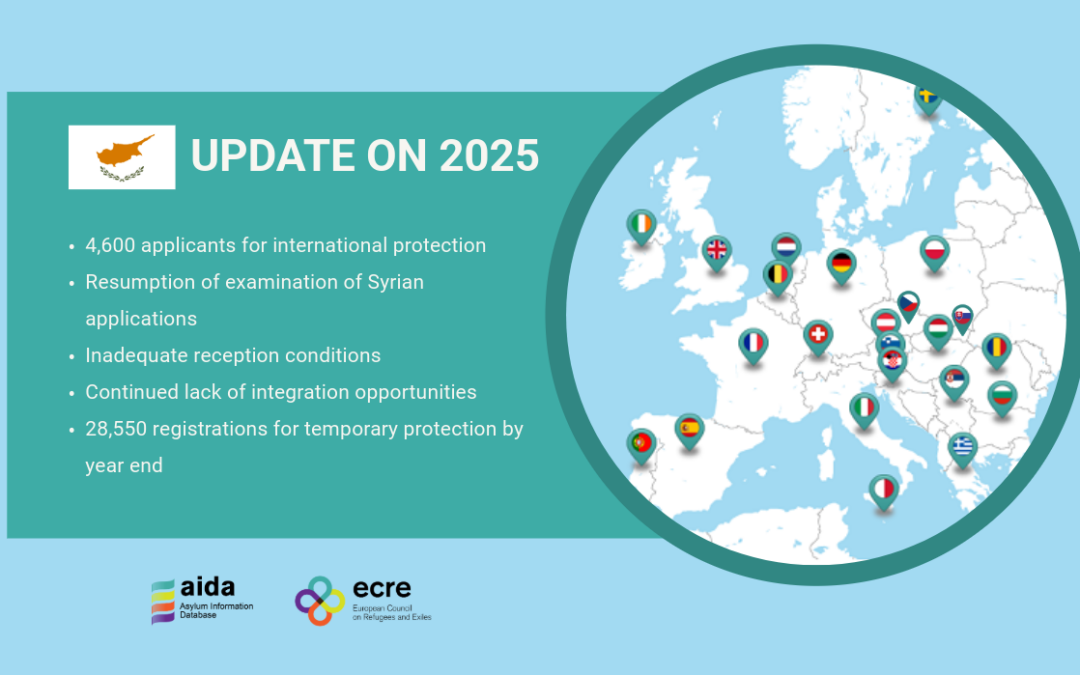
The updated AIDA Country Report on Cyprus provides a detailed overview on legislative and practice-related developments in asylum procedures, reception conditions, detention of asylum applicants and content of international protection in 2025. It is accompanied by an annex which provides an overview of temporary protection.
A number of key developments drawn from the overview of the main changes that have taken place since the publication of the update on 2024 are set out below.
Statistics
- Asylum applications and decisions: 4,600 people applied for asylum in Cyprus in 2025 (8,664 in 2024). Decisions were issued for 9,827 people, with 470 being granted refugee status, 207 being granted subsidiary protection and 8,362 having their claims rejected. At the end of the year, 15,777 people were still awaiting a decision at first instance and 7,370 at second instance.
Asylum procedure
- Access to the territory: There were reports of the interception and subsequent pushback of boats carrying Syrians nationals who were trying to reach Cyprus in order to claim asylum in 2025. In addition, two incidents were reported in which authorities delayed granting access to asylum procedures or refused to receive asylum applicants who were stuck in the ‘buffer zone’.
- Resumption of examination of Syrian applications: Following the April 2024 suspension, the processing of Syrian asylum applications resumed in early 2025. There were widespread rejections, primarily based on the determination that applicants had originated from safe areas and had migrated for economic reasons rather than fear of persecution. This position was reinforced in early 2026 when the International Protection Administration Court (IPAC) rejected ten appeals from Syrian nationals based on the circumstances of the cases, namely that they involved men who were able to work, who did not have any vulnerabilities and who were neither members of minorities nor from specific areas. IPAC concluded that they did not face a real risk of serious harm or persecution upon return.
Reception conditions
- Receptions standards: Reception standards remained below adequate levels in 2025. Most asylum applicants were hosted in the community rather than in reception centres and many of them lived in extremely poor conditions.
- Access to the labour market: Employment for asylum applicants remained restricted until nine months after their application and, even then, they were only able to access employment in specific industries. These limitations led to a rise in informal work and discouraged companies from hiring people who were in the asylum application process.
- Insufficient safeguards for children: The number of refugee children (both accompanied and unaccompanied/separated) remained high. A major shift occurred in January 2026 when oversight of unaccompanied minor facilities shifted from Social Welfare Services to the Cyprus Asylum Service. Nevertheless, in 2025, many children lacked sufficient guardianship and legal counsel, and thus remained vulnerable to trafficking and exploitation. In addition, there were still no standardised procedures for determining the “best interests of the child”.
Detention of asylum applicants
- Statistics on detention: Although the total number of asylum applicants in detention remained minimal in 2025, the State still lacked a systematic approach to applying alternatives to detention. This was a concern even for people who had been identified as vulnerable.
- Detentions conditions: Since the Limnes Centre (which was supposed to include a pre-removal unit) did not open as expected in 2025, asylum applicants continued to endure poor detention conditions in police stations nationwide. This reliance on temporary holding cells created significant procedural hurdles, often preventing detainees from effectively accessing legal support or appealing their cases.
Content of international protection
- Withdrawal of protection status: An amendment to the Refugee Law which took effect in 2025 enabled authorities to revoke international protection for beneficiaries who have committed serious crimes after being granted status. Since this change, several withdrawal procedures have been launched against individuals involved in serious offences, including organised crime, trafficking and violent or sexual crimes.
- Lack of integration opportunities: The lack of integration opportunities remained one of the weakest elements of the system in 2025. The preparation of the National Strategy and Action Plan for the Integration of Third-country Nationals was concluded during the year and implementation is expected to start in 2026.
- Naturalisation: Very few international protection beneficiaries have been able to meet the strict citizenship criteria that were introduced by the 2023 legal reforms. As a result, there were very few naturalisation applications in 2025, even for people who were born in Cyprus or who arrived as children.
- Family reunification: Family reunification for refugees continued to be severely affected by processing delays that far exceeded legal timeframes in 2025. In addition, beneficiaries of subsidiary protection (98% of Syrians in the country) were still entirely ineligible for the process and often had to rely on irregular means to reunite with their families.
Temporary protection
- Statistics: As of 31 December 2025, 28,550 individuals had registered for temporary protection in Cyprus (24,823 as of 31 December 2024).
- Access to rights: Temporary protection beneficiaries had access to all rights included in the Temporary Protection Directive upon registration and, in most cases, without obstacles. They were given a small, one-off support payment and accommodation options remained limited. Access to both the labour market and education were immediate but there were limited support measures for the latter.
The full report is available here and the annex on temporary protection is available here.
For more information about the AIDA database or to read other AIDA reports, please visit the AIDA website.